Impression Sliders
2026/11/02A design support system that generates sliders from impression descriptions
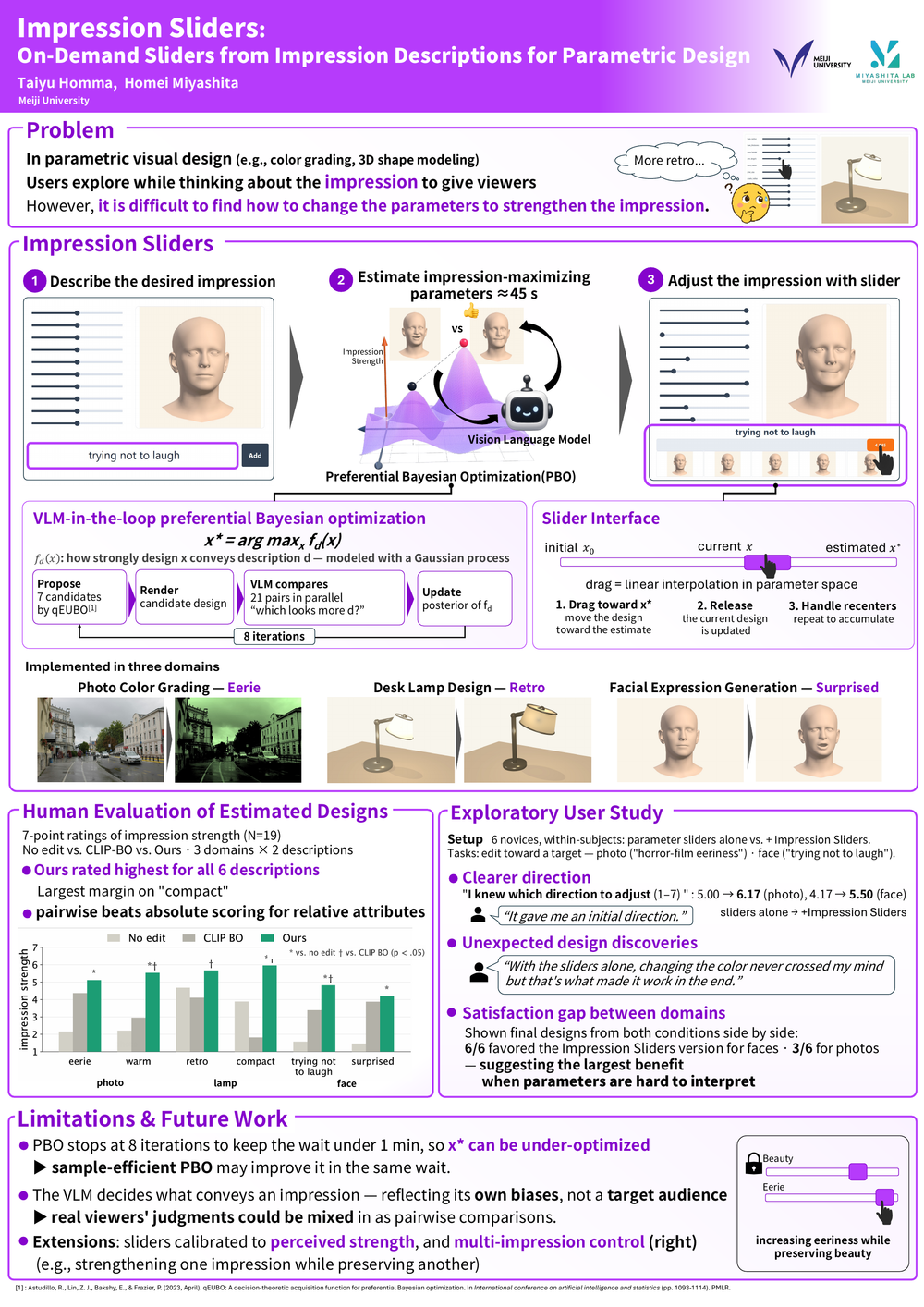
Impression Sliders is a system that takes an impression you want a design to convey, written in words, and generates a slider that moves the design toward that impression. For example, it helps when you want to give a photo an eerie mood, or make a face look like it is "trying not to laugh."
Photo color grading and 3D model shapes are determined by many parameters together. So even when users know the impression they want, it is hard for them to decide which parameters to change and by how much.
The system asks a vision-language model (VLM) to compare two designs and judge which one is closer to the given impression. Using these comparisons, it runs preferential Bayesian optimization and estimates, in about 45 seconds, the design that conveys the impression most strongly. That design is set as the end of the slider, so users can move their current design toward the impression just by dragging it.
In an evaluation with 19 raters, designs produced by our system conveyed all six impressions more strongly than those from CLIP-based optimization. An exploratory user study also suggested that Impression Sliders help users adjust designs toward a target impression, especially when the parameter space is hard to interpret. This work was accepted as a poster at UIST 2026, a top conference on user interfaces, and published in the UIST Adjunct Proceedings.
Below is the poster for UIST 2026.